Social Work Reclaimed by Steve Goodman Isabelle Trowler
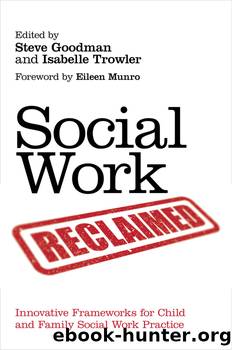
Author:Steve Goodman, Isabelle Trowler [Steve Goodman, Isabelle Trowler]
Language: eng
Format: epub
Tags: Nonfiction, Social & Cultural Studies, Social Science, Social Work
ISBN: 9781135421335
Publisher: Taylor and Francis
Published: 2013-10-11T04:00:00+00:00
Relationships within the unit: a secure base
The unit requires colleaguesâ willingness to expose individual practice and reflections within a group in order to work more collaboratively (Burnham 1986). Everyone will have an individual response to clients who can be challenging or display socially unacceptable behaviour. Some members of the staff team may empathise more than others depending on what the presenting issues are. At one point, a worker came back from a home visit with a young person and was able to be reflective and transparent enough to express how difficult they would find working with someone presenting racist and misogynist behaviour. This practitioner essentially found it hard to âlikeâ the young person. The unit meeting enabled more understanding and sympathetic voices to be heard about this young person within the context of their individual lives which enabled a discussion to be had about why this young person may have these views and what the meaning was for him and others. This in turn enabled further discussion about why this young person made such an impact on the worker, utilising Batesonâs GRRAACCEESS idea (Batesonn 1978). Through the GRRAACCEESS concept, practitioners are enabled to understand meanings for clients through becoming aware of the influences that may affect the clientâs unique position within the world. These influences include gender, race, religion, age, ability, class, culture, ethnicity, education, sexuality and spirituality. It is equally important to be mindful of how these influences affect us as workers in relation to our views and responses with clients. This type of discussion seemed rare within a traditional supervision or team meeting before, and it was most enriching. The value of creating a multiverse of possible descriptions and meanings to any given situation opens up possibilities for more positive relationships to form and meaningful support to be given that may not have been previously identified (Young et al. 1997).
These types of occurrences have led to hypothesising about what makes workers feel part of the unit and safe to expose their thoughts, prejudices and weak points of practice. Trust, support and a non-blaming atmosphere are important within the unit dynamics. Indeed, ideas about attachment have helped hypothesis about what is needed to create a secure base of mutual trust, respect and support in order for unit working to thrive. The role of the consultant social worker can perhaps be compared to that of a leader who nurtures an environment so staff feel comfortable in being curious and willing to explore varied hypotheses in respect of young people and their systems. The more secure workers feel within the unit, the less tightly scripted their assessments and responses, which in turn opens up other meanings and ways of moving forward with young people. Utilising systemic ideas about how we are organised in the unit invites a more recursive process inviting feedback. With hindsight it is possible to see how easy it was to react defensively about personal practice when working in a traditional team. However, social constructionist ideas have enabled
Download
This site does not store any files on its server. We only index and link to content provided by other sites. Please contact the content providers to delete copyright contents if any and email us, we'll remove relevant links or contents immediately.
| Anthropology | Archaeology |
| Philosophy | Politics & Government |
| Social Sciences | Sociology |
| Women's Studies |
Cecilia; Or, Memoirs of an Heiress — Volume 1 by Fanny Burney(32636)
The Great Music City by Andrea Baker(32609)
Cecilia; Or, Memoirs of an Heiress — Volume 2 by Fanny Burney(32010)
Cecilia; Or, Memoirs of an Heiress — Volume 3 by Fanny Burney(31996)
We're Going to Need More Wine by Gabrielle Union(19108)
All the Missing Girls by Megan Miranda(16320)
Pimp by Iceberg Slim(14667)
For the Love of Europe by Rick Steves(14579)
Bombshells: Glamour Girls of a Lifetime by Sullivan Steve(14137)
Norse Mythology by Gaiman Neil(13458)
Talking to Strangers by Malcolm Gladwell(13440)
Fifty Shades Freed by E L James(13291)
Mindhunter: Inside the FBI's Elite Serial Crime Unit by John E. Douglas & Mark Olshaker(9420)
Crazy Rich Asians by Kevin Kwan(9345)
The Lost Art of Listening by Michael P. Nichols(7548)
Enlightenment Now: The Case for Reason, Science, Humanism, and Progress by Steven Pinker(7354)
The Four Agreements by Don Miguel Ruiz(6835)
Bad Blood by John Carreyrou(6671)
Weapons of Math Destruction by Cathy O'Neil(6365)
